Myo-inositol versus D-chiro-inositol

How are they similar? Different? Which one is right for me?


There has been a lot of buzz recently about myo-inositol and PCOS. Some of the “articles” circulating on sites like the Examiner read much less like a serious journalistic endeavor and much more like a paid advertisement for a particular brand of myo-inositol. I’m writing this piece to give a more balanced account of the primary literature on myo-inositol, D-chiro-inositol, PCOS and insulin resistance. Here you’ll find evidence-based reasoning and hopefully decide which form of inositol is right for you to try. This is a very big topic, but along the way, I hope to inform anyone reading this of the similarities and differences between myo-inositol and D-chiro-inositol.


Let’s start with some important biochemistry terminology. This will give us a common language, provide context for the discussion and illustrate the most fundamental difference between myo-inositol and D-chiro-inositol. In the terms of biochemistry, myo-inositol and D-chiro-inositol are what are known as chiral epimers of each other.


The easiest and most common analogy used to explain chiral epimers is the human hand. Take a look down at your hands right now. You’ve known your whole life that your left and right hand are mirror images of each other. Now, lay one hand on top of the other. You’ll immediately notice that they are not superimposable — meaning they don’t neatly overlap. That is the essence of chiral epimers; chiral epimers are any two molecules which are non-superimposable mirror images of each other, like your left and right hands. This is a very important concept in biochemistry. And, it is the most fundamental difference between myo-inositol and D-chiro-inositol. They have the same exact molecular weight and are made of all of the same atoms attached in exactly the same ways, except that one is like your left hand and the other is like your right hand. This has some important biochemical consequences and leads to all of their functional differences.


Probably the most important similarity between myo-inositol and D-chiro-inositol is that they are both used during insulin signal transduction³. They both serve as second messengers, with different but equally necessary and complementary roles. Both are crucial to good health, and a deficiency in either can lead to sub-optimal wellness. They are both used in different tissues of the body in a variety of roles. For example, D-chiro-inositol activates an enzyme called pyruvate dehydrogenase, which is a very important energy metabolism enzyme. Activating it is an important step in proper glucose disposal. Myo-inositol has several important roles too. And insulin signaling is a very active area of research, so our understanding is improving every year. In addition to insulin signaling, myo-inositol and D-chiro-inositol are used in a variety of other signaling pathways. But let’s not get sidetracked with signaling pathways aside from insulin.


The insulin signaling pathway is particularly interesting in PCOS. This is because one of the most common features of PCOS is insulin resistance. In fact, even PCOS women who aren’t insulin resistant at the time that they’re diagnosed with PCOS are more likely to develop insulin resistance later in life than their peers without PCOS. And PCOS women with insulin resistance are more likely to develop type II diabetes and metabolic syndrome (aka syndrome X), which are themselves risk factors for a host of health problems. Based on this observation, lots of research has tried to identify genetic risk factors for PCOS by looking at genes related to insulin metabolism. To date, the results have been hazy, with no clear genetic causes for PCOS. Studies have largely focused on genes that are known risk factors for type II diabetes. However, a large body of evidence points to errors in inositol metabolism as a possible cause for PCOS.


Identifying genetic factors in inositol metabolism is a focus of active research. The conversion of myo-inositol to D-chiro-inositol is particularly interesting because errors here have been strongly implicated in PCOS. The conversion is also interesting because Myo-inositol is abundant in a variety of foods and D-chiro-inositol isn’t¹. In fact, urinary excretion of D-chiro-inositol has been shown to be greater than dietary intake in healthy adults. This means that the body must make D-chiro-inositol. Strong circumstantial evidence supports the theory that the body makes D-chiro-inositol from myo-inositol. And more evidence suggests that some people are less able to make this conversion than others. An inability to make this conversion would lead to an imbalance in the ratio of D-chiro-inositol to myo-inositol. And, since both are necessary for separate but complimentary roles in insulin signaling, changes in either direction could have negative effects.


One model for the etiology of PCOS proposes that impaired conversion of myo-inotiol (MYO) to D-chiro-inositol (DCI) leads to an elevated ratio of MYO/DCI. This in turn leads to overproduction of testosterone and all of the other symptoms of PCOS. Some people take this model and see it as black and white: either you make the conversion or you don’t. This leads to a lot of bad hypotheses and incorrect conclusions. Considering the spectrum of human genetic diversity (take height for example), why should this trait be black/white, yes/no, or on/off? With a little imagination, we can see this impaired conversion of myo-inositol to D-chiro-inositol as a spectrum. Some women make the conversion efficiently, and they have no symptoms of PCOS. Others may make the conversion with some degree of efficiency, but not quite enough to have an optimal MYO/DCI ratio. Their symptoms may be mild. At the other end of the spectrum some people would be completely unable to make this conversion, and they would consequently present with the most severe symptoms. And, as part of the human tapestry, there would be everything in between as well.


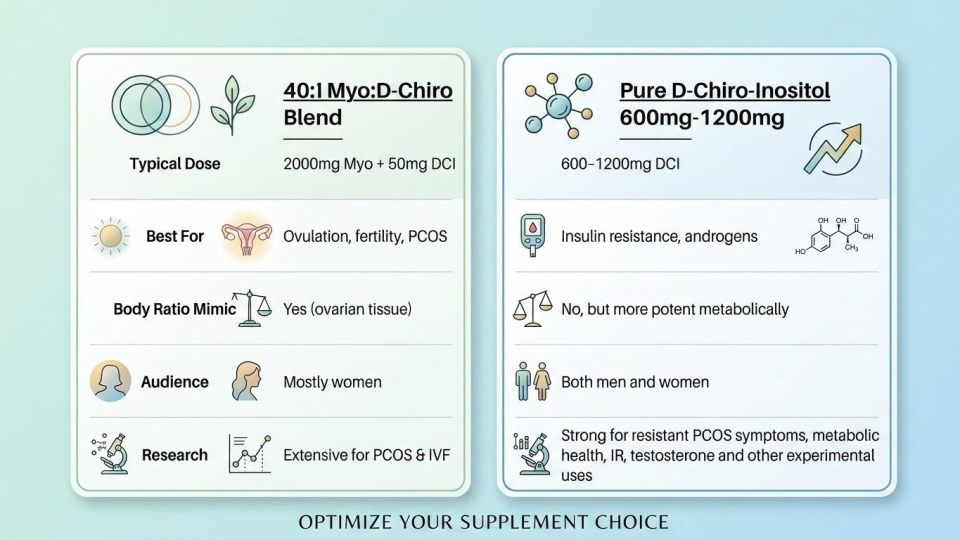
Which brings us to the question of which inositol is right for me? Along this spectrum, people who are completely unable to convert myo-inositol to D-chiro-inositol are only going to benefit from supplementation with D-chiro-inositol. Other people who make the conversion, but with less than optimal efficiency, may benefit from large doses of myo-inositol. And, folks in between, might see the best results from a blend of the two. Interestingly, clinical trials have shown that large doses of myo-inositol (4000 mg daily) benefit women with PCOS and smaller doses of D-chiro-inositol (1200 mg daily) benefit women with PCOS also. It might be tempting to think that there is a conflict here, that one set of studies must be false. But, keep in mind the following; clinical data are always averages. If you take a group of women with PCOS all along the spectrum, some might see phenomenal results with myo-inositol and others might see phenomenal results with D-chiro-inositol. But, on average, both treatments will appear to be effective. And, if you review the literature on D-chiro-inositol, myo-inositol, and PCOS, you’ll find that they all dovetail very nicely with the view of PCOS as s spectrum of impaired conversion of myo-inositol to D-chiro-inositol.


This is far from the whole story of PCOS, but it is a good introduction, I hope. And, hopefully, it will help readers decide whether to choose myo-inositol or D-chiro-inositol: that is, to choose what works for them. Inositol metabolism is by no means the whole story of PCOS; clearly environmental and lifestyle choices make a difference. And there are doubtless multiple genetic factors that contribute to the variation in both severity and type of symptoms that each individual has. But, the clinical successes (not to mention the anecdotal) of D-chiro-inositol are reconciled with the clinical successes of myo-inositol by thinking of PCOS as a spectrum. And, after all, as anyone who has ever been to a PCOS support group can tell you, PCOS comes in all shapes and sizes.


¹R S Clements, Jr, and B Darnell. “Myo-inositol content of common foods: development of a high-myo-inositol diet”. Am J Clin Nutr 1980 33: 1954-67. PMID 7416064.


² Sun TH, Heimark DB, Nguygen T, Nadler JL, Larner J (2002). “Both myo-inositol to chiro-inositol epimerase activities and chiro-inositol to myo-inositol ratios are decreased in tissues of GK type 2 diabetic rats compared to Wistar controls”. Biochem. Biophys. Res. Commun. 293 (3): 1092-8. PMID 12051772.


³ Nestler JE, Jakubowicz DJ, Iuorno MJ (2000). ”Role of inositolphosphoglycan mediators of insulin action in the polycystic ovary syndrome”. J. Pediatr. Endocrinol. Metab. 13 Suppl 5: 1295-8. PMID 11117673.


⁴ Larner J (2002). “D-chiro-inositol—its functional role in insulin action and its deficit in insulin resistance”. Int. J. Exp. Diabetes Res. 3 (1): 47-60. PMID 11900279.


⁵ Nestler JE, Jakubowicz DJ, Reamer P, Gunn RD, Allan G (1999). “Ovulatory and metabolic effects of D-chiro-inositol in the polycystic ovary syndrome”. N. Engl. J. Med. 340 (17): 1314-20. PMID 10219066.


⁶ Luorno MJ, Jakubowicz DJ, Baillargeon JP, et al (2002). “Effects of d-chiro-inositol in lean women with the polycystic ovary syndrome”. Endocrine practice 8 (6): 417-23. PMID 15251831.

Alice Juarez says:

I am currently taking DCI 1200 mg. Should I be taking myo-inositol as well?

Chiral Balance says:

Hi Alice,

That is an excellent question. I think the best answer is that it couldn’t hurt to try. If you have had success with DCI, but you feel like trying MYO as well, then by all means do so, particularly if you feel like your symptoms and severity are moderate.

sciquest says:

If the spectrum of PCOS is explained by a spectrum of conversion disorder from myoinositol to d-chiro-inositol, and this resulting in a elevated ratio of myoinositol:d-chiro-inositol, then how is it that supplementing with myoinositol could ever relieve PCOS symptoms, as many studies have shown that it can, albeit at higher doses than with DCI? Shouldn’t supplementing with myoinositol only raise the ratio of myoinositol:DCI? Does supplementing myoninositol “push” the conversion?

Chiral Balance says:

Hi sciquest,

Good question. I’m sorry if this wasn’t clear from the original article. Yes, if someone has a poorly functional – rather than non-functional – epimerase, then overwhelming it with substrate (in this case MYO) could in principal increase conversion. This phenomenon is often called mass action and, yes, I guess it would be fair to describe the extra MYO as “pushing” the conversion. Of course, as your question correctly intuits, a person with a non-functional epimerase would have her/his MYO/DCI ratio worsened.

7mom5 says:

Diagnosed with PCOS years ago, had no fertility problem at all, but other PCOS symptoms (severe hirsutism, obesity), postmenopausal. Adult daughter now showing symptoms too (some hirsutism, irregular & heavy periods, obesity). I’m considering DCI, but not sure. Currently taking 20 mg spironolactone (which is not helping me), 1000 mg metformin ER, 40 mg simvastatin, and the following supplements: Centrum silver multivitamin, vitamin D, cinnamon, CoQ 10 and occasionally vitamin B complex (for my nails). Will the DCI be compatible with these? How soon on average does one see results in terms of the hirsutism? When taking DCI, are there any blood tests which need to be periodically run to make sure it’s doing no harm to my body? What is the doctor-recommended dosage for DCI? I’ve read 600 mg per diem in one place and 1200 mg per diem in another.

Chiral Balance says:

Hi 7mom5,

The answer to most of your questions stems from DCI’s identity. D-chiro-inositol is a B vitamin, so there is no need for monitoring and it is compatible with everything you’ve mentioned. The one caveat is the spironolactone. Since DCI lowers testosterone in PCOS women and since spironolactone is an androgen antagonist, taking both at once is unnecessary and could potentially lead to clinical symptoms of low testosterone (just as undesirable as high testosterone). Since it sounds like the spiro isn’t helping you anyway, you might want to discuss discontinuing it with the prescribing physician. Also, it is important to keep in mind that after menopause, the ovarian-hypothalamic-pituitary axis really stops having such a prominent role in sex hormones, and so DCI may not be as helpful. In other words, once you’re postmenopausal your testosterone is high for other reasons aside from PCOS, which DCI does not address. You daughter, however, would be more likely to benefit from DCI supplementation. I don’t want to discourage you and we have had several postmenopausal women take DCI with great results, but I also don’t want to imply
The recommended dose of DCI is 10-20 mg daily per 100 kg of body weight. What that breaks down to is one 600 mg capsule for every 130 pound increment of body weight. So,
<=130 pounds – one 600 mg capsule daily
131-260 pounds – two 600 mg capsules daily
etc.
We recommend an 8 week trial of DCI and note that the most immediate improvements are typically mood, energy level and blood sugar and one of the longest-term improvement is hirsutism.

Heather says:

I’ve taken the recommended dose of DCI for the past 6 weeks but find I’m actually gaining weight! Does this mean I should in fact be trying large doses of myo-inositol (4000 mg daily) for my PCOS rather than DCI?

Chiral Balance says:

Hi Heather,

Many women with PCOS, especially those with severe oligomenorrhea or amenorrhea are not used to having a cycle. For some, cyclical water weight can come as a surprise and be very discouraging. However, this is usually transient and a sign that a normal cycle will resume soon. So, I encourage you to finish an 8 week trial, and if you then decide to try myo-inositol, please just let us know.

AnaMaria says:

Hi there,
I am 24 years old, have a mild type of PCOS due to a pelvic ultrasound (small cysts measuring 6-8 mm on each ovary), my menstrual cycle is quite normal (every 28-30 days), I am underweight, my diet is healthy, no dairy, no sugar. My only problem is acne and I have noticed that my hair is thinner than it used to be. During a year of healthy lifestyle, natural supplements, colonic therapy and liver flushes, my acne hasn’t changed at all, even the contraceptive pill, Yasmine is not working anymore as it used to be.
Last month I started taking spironolactone and it finally cleared my skin. Considering the how spironolactone acts, blocking androgens, I suppose my body produces too many male hormones other than testosterone as my testosterone level is lower than normal, my T3 level is fine which indicates a good thyroid function, but surprisingly my adrenals are in a bad state( adrenal exhaustion) but again I have no other symptom of adrenal fatigue, but acne.
Please let me know your advice and if one of the supplements above would be effective for me and which one. I mention I don’t have weight problems, acne being my only symptom.
Thank you very much for the possibility of writing you.

Terry Wyrick says:

I am wondering which inositol I should try? I have had PCOS for a long while and have fatty liver with scarring. Along with challenging weight loss ,random hair growth, dark spots inside my legs AND skin tags. I have started taking Metformin 500 mg to reduce glucose levels. I have had a complete hysterectomy, so no babies in the future. I am desperate to feel better and lose the weight. I suffer from depression and take Welbutrin 150 mg x a day. I have had so many health issues including 11 surgeries. I am a single mom so I just don’t have a lot funds to spend either. Please help me out! thanks

Chiral Balance says:

Hi AnaMaria,

A few things that you might want to discuss with your doctor:
Free versus total testosterone. Testosterone can float around in your blood either “free,” which is exactly what it sounds like, or “bound”, in which case it is bound to a protein called sex hormone binding globulin (SHBG for short). Bound testosterone can be readily converted to free testosterone and serves a reserve, so to speak. So, a person with low free testosterone and high bound testosterone will still have high total testosterone. This free/bound/total distinction is worth clarifying with your physician, and if you blood work has only looked at one of the figures, the others should also be evaluated. Also, as you noted, there are other androgens, like DHT, DHEA and DHEA-S, that can be elevated. D-chiro-inositol was also shown to lower DHEA and DHEA-S in clinical trials.

Chiral Balance says:

Hi Terry,

Well, I don’t want to make the decision for you. It sounds like you’ve for pretty severe insulin resistance and you should try one or the other for sure. Incidentally, the dark spots and skin tags are called acanthosis nigricans, and this is a sign of long-term insulin resistance.

pcoshelp says:

I have had pcos since I was 17. Never had a period on my own except maybe a few times. Last year I was taking metformin and I started getting my period on my own. Lost my health insurance and had to stop taking it. Now I have not had a period since February. I was looking up DCI but no natural grocery store has it. They only have inositol. No myo either. So is that the same thing as the other 2 or should I be looking on line to order DCI or the myo 1?

Chiral Balance says:

Hi,

Regular “inositol” that you can find a lits of pharmacies and vitamin stores is myo-inositol. There are only a few retailers of D-chiro-inositol and we are the oldest one in business today. Our product is on shelves in some pharmacies, but for most people it is easier to order online.

ivypai says:

I have PCOS, I ate the DCI a month, 600mg/day, but my cycle from 21 days became 15 days,what’s happend

Chiral Balance says:

Hi Ivypai,

We recommend an 8 week trial of DCI. Along the way to a normal cycle, several hormones have to be normalized.

mary says:

What is the difference between d-pinitol and d-chiro-inositol?

Devi says:

Hi,

I just want to know which is the best supplement for PCOS Whether DCI or Myo inositol. Kindly give me the suggestions.

Chiral Balance says:

Hi Mary,

D-pinitol is another of the family of stereoisomers to which DCI and myo-inositol belong. In theory, your body should be able to convert one to other by means of an enzyme called an epimirase.

Chiral Balance says:

Hi Devi,

As this article makes clear, there is no simple answer: every woman is different.

Sen says:

Hi,
How can we identify the conversion of myo inositol to DCI. & Normally the human body contains DCI as their own or not.

Chiral Balance says:

Hi Sen,

Currently, there is no test to be able to determine whether or not a person is able to make the MI to DCI conversion.

evans paul says:

which is the best inositol in pcos either myoinosotol or d chiro inositol

Chiral Balance says:

Hi Paul,

As this article makes clear, there is no simple answer: every woman is different.

Hi, I was just diagnosed with Pcos. I have a slight case as the doctor put it. My fasting sugar is 105 and my DHEA is 165. I was put on diet pills to help lose weight and I stopped because I felt they were unhealthy for my body. Dr put me on 1000mg of metformin which made me sick. I stopped the metformin and have been on myoinsitol for about 2 weeks. I take 1500mg a day and noticed a slight decrease in my anxiety but not a whole lot of weight loss yet. I work out 5 x a week and have been doing this for over a year but no weight loss. My question is can I take both myinsitol and the D chiro together? And how long before I should notice some difference???

Chiral Balance says:

Hi Dina,

Quick answer: yes, you can take DCI and MI together. Women taking DCI usually know whether it works for them within eight weeks, often sooner.

Women often take much more MI than that. A leading manufacturer recommends 4000mg a day. But, they also make no dispensation for how much you weigh, which is troubling. I really can’t say much more about it than that.

One thing you should consider is that if you increase your dose of MI AND start taking both together and see good results, you won’t know which one is working. I suppose this is a better problem to have than the one you have now, so I’ll leave that to your judgement.

The problem with weight loss is fairly universal in women with PCOS. When your body is unable to burn sugar because of insulin resistance, most of it goes into fat cells, regardless of your activity level. It is very frustrating.

Fiona says:

My daughter has has success with D Chiro Inositol giving her periods for past 6 moths (2 per day) however during this time she has gained over 10 lb, which is very worrying. She is on 1000mg of extended release metformin. She runs, eats low carb yet weight progressively creeping up.

Chiral Balance says:

Hi Fiona,

This is definitely not the typical response to DCI, but I have heard a similar story from a few women over the years. However, this is different because of the steady increase you described. Most women who have reported an increase in weight found that it was nearly immediate and in most cases it turned out to be water weight related to their cycle, which many had never had before. For these women, it typically resolved on its own over the course of their cycle as the water weight came back off. Your daughter’s case is certainly a little more puzzling. Ultimately, D-chiro-inositol is a part of normal insulin signaling, and so it enhances glucose disposal. One of the possible fates of glucose is to be stored as fat, but that doesn’t sound likely since she is eating right and exercising. Without a more complete history, I can’t even speculate what other factors might be causing this weight gain. So, if the only thing new in her regimen is DCI, and if you feel confident that DCI is the culprit in this unexpected weight gain, then the only answer might be to decrease the amount of DCI she is taking to 600 mg daily, or to stop DCI altogether. If the weight gain doesn’t stop soon, she my want to consider those 2 options. I would also encourage a quick review of other changes to her medications/diet/exercise to maybe find another explanation as well.

kathy says:

Will IP6 help at all?

Chiral Balance says:

IP6 is a phosphorylated form of myo-inosotol (in fact, it has 6 phosphoryl groups). I dislike it for a variety of reasons, not least of which is that it can negatively impact mineral absorption. Additionally, it has never been shown to have any clinical benefits for women with PCOS. I can’t recommend IP6.

Karen says:

I was diagnosed with elevated DHEAS. I am now post-menopausal. I was taking Flutamide and BC which controlled it well, and eliminated the hirustism and very oily complection. Once, post-menopausal, I was no longer taking BC, but continued the flutamide. But, the GYN that prescribed this retired, and my new doctor is reluctant to continue to prescibe the flutamide due to potential liver problems. So, until I see her to discuss other options I have been trying Myo- and D-chiro inositol. The hirsutism hasn’t returned (yet, anyway) but my hair and face are very oily. Saw Palmetto seems to cause acne. I do not have any adrenal masses, but one of my adrenals does have an unusually thick stem. Anyway, I have a couple of questions:which inositol would you recommend for elevate DHEAS most likely originating from the adrenal glands? And why would saw palmetto cause acne? I didn’t take it for very long for that reason. I know that your website seems more oriented towards women with PCOS, but I was hoping you could help me in my situation. Thank you.

Shannon says:

I just want to make sure I understand this correctly although I know there is no cut and dry answer! I have PCOS but have no symptoms other than no ovulation/extremely long cycles(like 6 months!). I weigh 110 lbs at 5’4 and we are TTC so the anovulation makes it a little tricky. I’m assuming that I am able to convert the MI to the DCI which is why I have next to no symptoms so would you recommend the MI to try first because of this? Any idea on a dose? Also is there a list of pharmacies or stores in Canada that carry your DCI to avoid the shipping/customs? THANK YOU!

Chiral Balance says:

Hi Karen,

In regards to whether Myo-inositol or D-chiro-inositol is appropriate for you, I think that you should try just one and then, if necessary, the other. If you are taking both at once, it may be impossible to know which is providing any benefits. You might want to start with myo-inositol – you can get it over the counter and it is relatively affordable just about anywhere. If it works, you’ve found your solution. If not, you can try DCI. All of that being said, it is also possible that neither will help. The underlying problem might not be a deficiency in either, in which case supplementation will not provide any benefits. Saw palmetto works by inhibiting conversion of testosterone to DHT, a more active form of testosterone. Initially, this might cause a slight bump in total testosterone as some of the feedback that regulates testosterone production would have to adjust to lower DHT. That, though, is speculation; ultimately, if it didn’t work for you, I can recommend trying saw palmetto again.

Chiral Balance says:

Hi Shannon,

This is exactly the sort of thought process we were hoping to encourage with this article! I’m glad you read it and were able to have the “oh that sounds like me” epiphany and start considering your options. I think it is probably worth your time to try Myo-inositol first. You’ll want to take 2000 mg twice daily, which makes it just about as expensive as DCI in the long run, but much easier to find in Canada as well – you can probably get it at just about any pharmacy. Unfortunately, we don’t have any retailers in Canada. If Myo doesn’t work for you, which is always possible, then DCI would be the next thing to try.

Joe says:

Hi, I’m not understanding in what scenario myo inositol would be better. If someone has no conversion or bad conversion they should take chiro. If they have good conversion what’s the downside to still taking chiro?? Besides cost…

Chiral Balance says:

Hi Joe,

That is an excellent question. Even cost (once you factor in the much larger dose of myo-inositol) is not overwhelmingly different. Availability is a factor though – virtually any pharmacy in any country will have (or be able to order) myo-inositol. DCI on the other hand is less common. All of that being said, the pathways involved are even more complex than was discussed in this article and there are problem women with PCOS who would see no improvement with either form of inositol. Ongoing research should help to clarify the underlying causes of PCOS and hopefully someday, there will be a simple cheek swab that can identify the exact underlying cause for individual women and tailor their treatment accordingly.

Pauline says:

Hello. I am trying Inositol for anxiety, related to adrenal exhaustion. BUt, I also have glucose intolerance/insulin resistance. How does inositol effect this in my situation?
I don’t want to make things worse. And, is there any advise on which Inositol would be right for me, Myo or D-chiro?
I finished a brand of Inositol from Source Natural and started a new brand from Swanson Vit. And did not benefit at all today from taking it.

Chiral Balance says:

Hi Pauline,

Unfortunately, I’m not intimately familiar with renal exhaustion or its contribution to anxiety. However, my understanding of the role of myo-inositol in managing anxiety not related to renal exhaustion is that it helps correct an imbalance second messengers used in the brain, some of which contain various forms of inositol. DCI, to my knowledge, has never been clinically evaluated for anxiety. It is possible that you are deficient in both, but regrettably, there are too many unknowns for me to even make a firm suggestion, particularly considering the renal exhaustion component. If you continue to take myo-inositol (regular over-the-counter “inositol” is myo-inositol), you should allow a few weeks for it to work and possibly consult with a functional medicine doctor or psychiatrist to help develop a more comprehensive wellness strategy. Perhaps working on the underlying kidney issue would help to resolve the other related problems.

Ask a Question or Leave a Comment

Your email address will not be published.

 (require)